Build or Buy Your Borrower Portal? Get the Framework Before You Commit.
A practical guide to comparing total cost, risk, and long-term ownership, so Operations, Finance, and IT can make the call together.
A borrower portal looks like a simple project until you add up the integrations, security reviews, accessibility testing, and the people needed to keep it running. Many organizations underestimate the time, cost, and complexity involved.
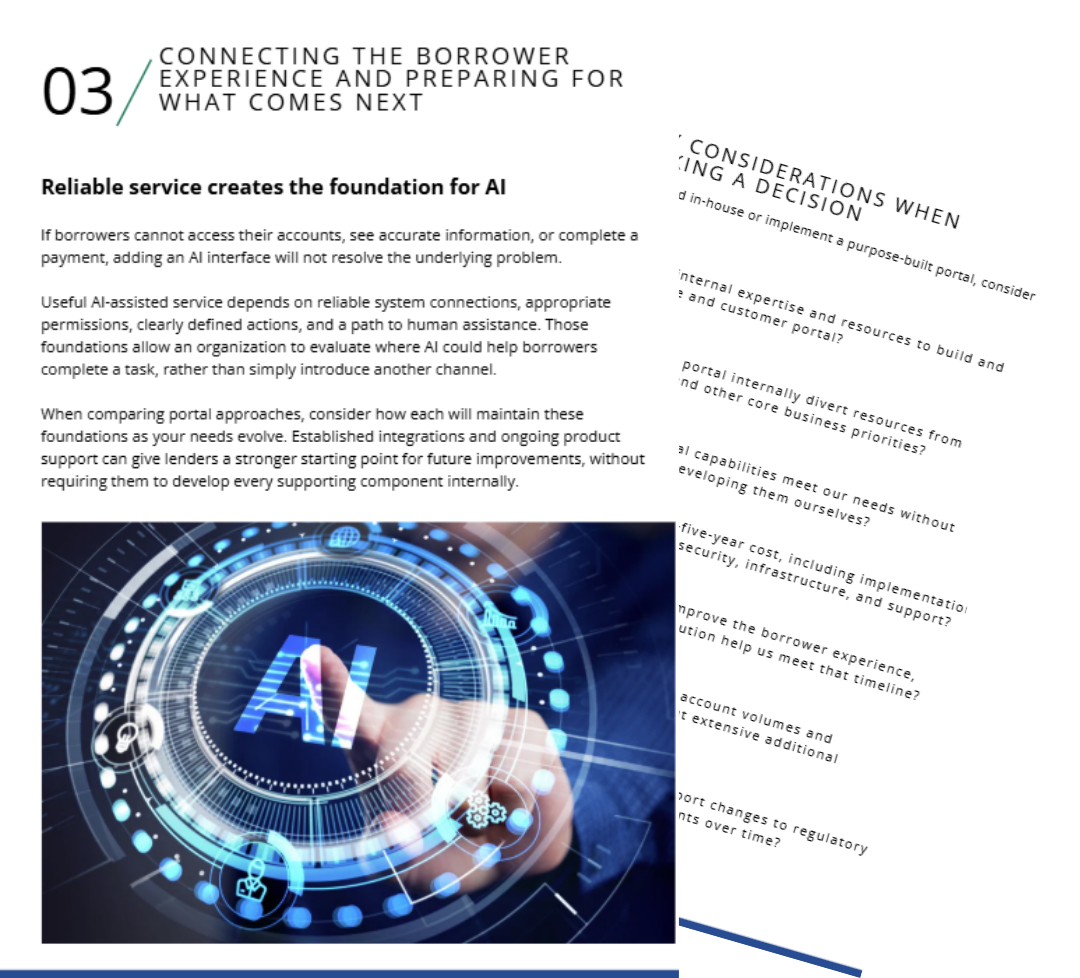
This eBook gives you a side-by-side way to evaluate both paths, using the same borrower requirements and the same three-to-five-year planning period, so the decision holds up in front of your CFO, your CIO, and your COO.
Download your free eBook!
Why It Matters to Your Role
Operations Every payment question, statement request, and "where's my notice?" call lands on your team. This guide shows how a well-connected portal lets borrowers help themselves, and how to avoid a build that delays relief for your servicing staff.
Finance The sticker price of a build is rarely the real price. Learn which costs to include over three to five years, from staffing and infrastructure to security assessments and upgrades, and how to count the cost of delay.
IT Delays, budget overruns, and unreliable data exchanges are real risks, and so is losing the one person who understands your custom integrations. See how to weigh control and customization against long-term maintenance and ownership.

What You'll Learn
True cost of ownership: Compare build and buy over 3-5 years.
10-factor comparison: Cost, security, integration, scalability, and more
Realistic timelines: What building in-house actually takes
Seven decision questions: Pressure-test your readiness before you commit
"Our customer portal is designed to make life easier for both businesses and their customers without placing extra strain on customer service teams." Lee Nagel, President, DataOceans
Not A Sales Pitch for One Answer. A Framework for the Right One
Building offers control and customization. Buying can reduce the development and maintenance burden. Either path still requires integration, internal oversight, and a plan for long-term ownership.
The right approach is the one that supports the borrower experience you need and that your organization can sustain as its needs change. This eBook helps you prove it.